

Trailblazing Polish Women Who Shaped History: From Monarchs and Scientists to Sports and Cultural Icons

Beata Bruggeman-Sekowska
Poland has been home to extraordinary women whose groundbreaking achievements have shaped not only the country’s history but also the course of global culture, politics, and sports. From the medieval queen who united nations, to the pioneering athletes and artists who broke barriers and inspired millions, these women carved paths where none existed. Each one, in her unique way, has defined what it means to be a force for change, leaving a lasting mark on history. This article explores the remarkable lives of these Polish icons—women whose leadership, vision, and resilience continue to echo through time. The list will be updated over time as more names and stories are added. Due to copyright issues, the article will not include any photos or images of the discussed women.
Jadwiga of Poland (1373–1399) —crowned in 1384, holds a unique place in history as the first female monarch of Poland, earning the title of “King” during a time when female rulers were rare in Europe. Jadwiga played a pivotal role in uniting Poland and Lithuania through her marriage to Jogaila (later Władysław II Jagiełło), a union that facilitated the Christianization of Lithuania and strengthened the region politically and spiritually. Despite her royal status, she is best remembered for her humility, piety, and dedication to the welfare of her people. She generously donated most of her personal wealth — including the royal insignia — to charity and education, funding and restoring numerous schools and hospitals. In recognition of her leadership and selflessness, Jadwiga was canonized as a saint in 1997. She is remembered as a wise and compassionate monarch whose contributions significantly shaped Poland’s national and spiritual identity.
Nawojka ( 14th/15th century) – is considered the first historically acknowledged female student and teacher in Poland. She disguised herself as a boy to study at the University of Kraków (later Jagiellonian University) in the 15th century, a time when women were not allowed to attend universities. Under the name Andrzej (or Jakub), she successfully enrolled and excelled in her studies for two years before her true identity was exposed. When questioned, she famously declared her motive as “For the will of learning.” Although she was not convicted of any crime, the judges chose not to fully acquit her, and she was requested to join a convent. There, she took her vows, became a teacher and leader of the convent school, and eventually became the abbess. Her legacy continues to be honored, with the first women’s dormitory at Jagiellonian University opened in her name in 1936. One of the streets in Kraków is also named after her.
Marie Casimire Louise de La Grange d’Arquien (1641–1716), affectionately known as Marysieńka, was a French noblewoman who became the queen consort of Poland and grand duchess consort of Lithuania from 1674 to 1696 through her marriage to King John III Sobieski of the Polish–Lithuanian Commonwealth. Her influence on state affairs was significant, and with her husband’s approval, she often acted as regent during his absences, especially when he was engaged in military campaigns. The royal couple became famous for their heartfelt love letters, written between 1665 and 1683, when they were separated due to Sobieski’s military duties or her travels to Paris. These letters offer a glimpse into their deep affection for each other, as well as their thoughts on contemporary issues, royal matters, and daily decisions—many of which Sobieski consulted her on. After their deaths, these letters were published and helped cement the affectionate nickname “Marysieńka” for the Queen, a term of endearment used by her husband, and she remains widely remembered by that name in Poland.
Elżbieta Sieniawska (1669–1729) —was a Polish noblewoman, diplomat, and Grand Hetmaness of the Crown, renowned for her significant political influence and patronage of the arts. One of the wealthiest individuals in the Polish-Lithuanian Commonwealth, she controlled vast estates and wielded considerable power. Known for her wisdom, strategic mind, and shrewdness, Sieniawska played a key role in shaping the country’s political landscape during the reign of Augustus II the Strong. She was actively involved in the Great Northern War and Rákóczi’s War for Independence, where she took on diplomatic and military duties often assigned by her husband. Her influence extended to the royal court, where she formed vital political alliances, earning her the title of “the uncrowned Queen of Poland.” A patron of arts and architecture, she left a lasting legacy, not only as a powerful politician but also as a cultural and intellectual figure in her time.
Magdalena Bendzisławska (17th/18th century) —is considered the first official female surgeon in the history. Born in an era when medicine was almost exclusively male-dominated, she defied the norms and proved that women were just as capable in the field. After the death of her husband, Walenty Bendzisławski, a surgeon at the Wieliczka Salt Mine, Magdalena took over his practice. She had already acquired significant medical knowledge, learning under her husband’s supervision, and was skilled enough to independently run the practice.In 1697, after her husband’s passing, she received a royal privilege from King Augustus II the Strong, officially allowing her to continue practicing surgery. Her contributions to the Wieliczka Salt Mine are commemorated by a memorial plaque, unveiled in the mine in 2012, honoring her as a pioneer who opened doors for future generations of women in medicine.
Maria Leszczyńska (1703–1768) was a Polish princess who became Queen of France by marrying Louis XV in 1725. She had a profound impact on both the layout of the Palace of Versailles and the artistic life of her time. Although not involved in politics, she was deeply religious and devoted to philanthropy, earning great popularity among her subjects. She founded a school for poor girls near Versailles, demonstrating her commitment to education and social welfare.She was highly cultured, spoke several languages, and had a deep interest in literature, music, and the arts, particularly painting. During her 42 years at Versailles, Maria Leszczyńska was a patron of numerous artists, including painters Charles-Antoine Coypel, Jean-Marc Nattier, Jean-Baptiste Oudry, and sculptor Jean-Baptiste Lemoyne. She commissioned numerous portraits and works of art, which adorned the palace. Maria herself was an accomplished amateur painter. In her private apartments, she maintained an art studio, where for 15 years she trained under the painter Étienne Jeaurat. One of her works, Une Ferme (“The Farm”), is a faithful copy of Jeaurat’s original.
In 1748, she introduced porcelain flowers to the Versailles court, which became a fashionable decorative element. She commissioned these flowers from the Sèvres manufactory and displayed them in her apartments, inspiring the courtiers to adopt this trend. It is sometimes suggested that she played a role in hosting Mozart at the French court, marking an important cultural moment. Her long tenure at Versailles and her contributions to charity, education, and the arts left a lasting legacy.
Izabela Czartoryska (1745–1835) — known for founding Poland’s first museum, the Czartoryski Museum, preserving national treasures and historical artifacts. She was a Polish princess, writer, and art collector who played a significant role in the Polish Enlightenment. In 1796, she ordered the rebuilding of the ruined palace in Puławy and began assembling a collection that included Turkish trophies seized by King John III Sobieski at the 1683 Battle of Vienna, as well as Polish royal treasures and family heirlooms. In 1801, she opened the Temple of the Sibyl, also known as the “Temple of Memory,” showcasing objects symbolizing the glories and miseries of human life. Her palace in Puławy became a hub for intellectual and political discourse, reflecting her progressive ideals and leaving a lasting legacy as a cultural pioneer.
Maria Walewska, Countess Walewska (1786 –1817), was a Polish noblewoman who became a prominent figure in the court of Napoleon I. She used her position and influence to urge Napoleon towards the creation of an independent Polish state. Despite her personal feelings, Walewska claimed in her memoirs that she became romantically involved with Napoleon out of a deep sense of patriotism, seeing it as a means to advance Poland’s cause. In later years, she married Count Philippe Antoine d’Ornano. Together, she and Napoleon had a son, Alexandre. Maria Walewska had three sons:
Count Antoni Colonna-Walewski – her son from her first marriage, who settled in Poland. Little is known about his life.
Count Alexandre Joseph Colonna-Walewski– her son from her relationship with Napoleon I, who became an influential figure in 19th-century French politics. He served as a diplomat and cabinet minister.
Rodolphe-Auguste d’Ornano – her third son, who became an influential figure in French society. His descendants went on to create the renowned fragrance and cosmetics brand, Sisley.
Maria Szymanowska (1789–1831) —was a pioneering composer known as the first female composer from Poland to achieve both national and international recognition. She was one of the first professional concert pianists of the 19th century, and was one of the first pianists to perform a memorized repertoire in public. She performed across Europe, including in England, France, Germany, and the Netherlands, captivating large audiences with her virtuosity. At a time when concert halls were a new phenomenon, she achieved financial independence through her performances, a rare feat for women of the era. Szymanowska later became the court pianist to Russian Empress Alexandra Fedorovna and hosted a salon in St. Petersburg attended by prominent figures like Rossini and Goethe. Her works, mainly for piano, played a key role in shaping Polish Romantic music.
Klementyna Hoffmanowa (1798–1845) — was a pioneering Polish novelist, playwright, translator, teacher, social activist and the first Polish woman to support herself through her creative and educational work. She was also one of the first writers of children’s literature in Poland. During the November Uprising, she co-founded and chaired the Union of Patriotic Charity of the Varsovians, aiding wounded soldiers. After the uprising, she fled to Paris, where she became a key figure in the Polish émigré community, known as “the Mother of the Great Emigration.” She was friends with Chopin and Mickiewicz and played an important role in the cultural and political life of the émigrés.
Emilia Plater (1806–1831) —born in Vilnius into a noble Polish–Lithuanian family, she was a noblewoman and revolutionary who became a national symbol of resistance during the November Uprising 1830–1831 against Russian rule. Her bravery, leadership, and dedication to the national cause made her a celebrated hero in Poland, Lithuania, and Belarus, earning her the title of the “Polish-Lithuanian Joan of Arc.” She led a unit and earned the rank of captain in the insurgent forces. Emilia Plater fought courageously in battles, determined to continue the struggle even after the main forces decided to retreat.
Narcyza Żmichowska (1819–1876) —is considered a precursor of feminism in Poland. A novelist and poet, her work focused on women’s challenges in a patriarchal society, advocating for greater educational and social opportunities for women. Her works were influenced by Eleonora Ziemięcka. (read below) Through her writings, she questioned societal norms and highlighted the struggles women faced. In Paris she enrolled at the Bibliothèque Nationale, becoming one of the first women to engage with the French Academy. This time in France shaped her radical views on women’s rights, and she was considered “eccentric” for smoking cigars and rejecting marriage.Her literary debut came in 1846 with Poganka (The Heathen), where she explored her feelings for her close friend, Paulina Zbyszewska. Żmichowska also founded a suffragette group in Warsaw in the 1840s, involved in anti-Tsarist activities, and was arrested by Russian authorities in 1849.
Eleonora Ziemięcka (1819–1869) was a pioneering Polish philosopher and publicist, often regarded as the country’s first female philosopher. She focused on the role of women in society, especially advocating for reform in women’s education. In Myśli o wychowaniu kobiet (Thoughts on the Education of Women), she called for a modern education that addressed both emotional and intellectual needs, critiquing romance novels for fostering unrealistic expectations and emotional detachment.
In her 1860 essay “A Word About Women” published in Studia, Ziemięcka challenged stereotypes that idealized women as angelic or inferior. She argued for the recognition and respect of women’s dignity and individuality, grounding her views in religious philosophy. Ziemięcka’s work laid an early foundation for feminist thought in Poland.
Lucyna von Bachman Ćwierczakiewiczowa (1826 –1901) was a renowned Polish journalist and author, best known for her widely popular cookbooks. In 1858, she published her first book Jedyne praktyczne przepisy wszelkich zapasów spiżarnianych oraz pieczenia ciast (The Only Practical Compendium of Recipes for All Household Stock and Pastry). Her recipes were drawn from her own culinary experiences, as well as 17th and 18th-century memoirs of Polish nobility. Two years later, in 1860, she released 365 obiadów za pięć złotych (365 Dinners for 5 Zlotys).Throughout the 1870s, Ćwierczakiewiczowa published additional books on cooking, cleaning, and flower arrangement. She became a prominent figure in Warsaw society, hosting a salon at her residence on Królewska Street, frequented by notable writers and journalists, including Bolesław Prus.Her cookbooks made her immensely popular, with her first book going through 23 editions before 1924, selling over 130,000 copies worldwide—more than the combined total of works by famous authors like Henryk Sienkiewicz and Bolesław Prus.
Helena Modrzejewska (1840–1909) —was a trailblazing Polish actress, stage icon who achieved international fame for her powerful stage performances, particularly in Shakespearean roles. Born in Kraków, she began her career in Lviv and later performed in Kraków and Warsaw before moving to the United States in 1877. Remarkably, she mastered English quickly, becoming a star on major American stages, including New York, Washington, Philadelphia and Boston. Her repertoire spanned 260 roles, from comic to tragic characters, but she was best known for iconic roles like Lady Macbeth, Cleopatra, and Mary Stuart.
Countess Róża Maria Czacka (1876–1961), later known as Mother Elżbieta, was a visionary Polish nun and a pioneer in the field of education and care for the blind. After losing her sight at the age of 22, she transformed personal tragedy into a powerful mission that would shape generations. What made her truly unique was her groundbreaking work in typhlology—the study and support of the blind. She traveled across Europe to study modern practices and successfully adapted Polish phonetics to the Braille alphabet, which became the national standard for blind education from 1934 onward. In 1918, she founded the Franciscan Sisters Servants of the Cross, and established the Laski Center near Warsaw, which is still operating—an educational, spiritual, and care center for the blind. Laski soon became a symbol of hope, offering not only schooling and vocational training, but also shelter for war orphans, wounded soldiers, hidden Jews, and resistance fighters during World War II. Its hospital treated the wounded and its staff supported the 1944 Warsaw Uprising. She passed away in 1961 and was buried at the cemetery on the grounds of the Laski center. On September 12, 2021, Róża Czacka was beatified in Warsaw at the Temple of Divine Providence—recognizing her life of heroic virtue and the miracle attributed to her intercession. She is now venerated as Blessed Mother Elżbieta Róża Czacka, with her feast day celebrated on May 19. Today, her legacy continues through the Towarzystwo Opieki nad Ociemniałymi (Society for the Care of the Blind), based in Laski near Warsaw. This public-benefit organization provides comprehensive support to people who are blind or visually impaired—offering education, rehabilitation, social assistance, and spiritual care, all in the spirit of its founder’s enduring mission of compassion, dignity, and service. In recognition of her extraordinary contributions, the Polish Senate has named Blessed Elżbieta Róża Czacka one of the official patrons of the year 2026.
Jadwiga Szczawińska-Dawidowa (1864-1910) was an educational and social activist, journalist, and the founder of the Flying University. The secret self-education courses for women, who were denied access to higher education, were organized in private homes in Warsaw starting in 1882. In 1885, these courses evolved into an informal, secret higher education institution known as the Flying University. This underground educational organization operated covertly, frequently changing locations (hence the name of the university), at a time when Poland was under the control of the Russian Empire, offering educational courses outside the reach of the occupiers’ censorship. Over the course of 20 years, approximately 5,000 women graduated from the university, including Maria Skłodowska-Curie, who later won the Nobel Prize as well as the renowned Polish writer Zofia Nałkowska. The university also prepared women for studies at foreign universities. Almost all women from the Kingdom of Poland who obtained diplomas from foreign universities before 1905, mainly from Swiss, French, and Galician institutions, had first studied at the Flying University.
Olga Boznańska (1865–1940), born in Kraków, was one of the most influential Polish artists of the early 20th century. Renowned for her portraits, still lifes, and occasional landscapes, she gained fame for the psychological depth and symbolist atmosphere in her work. Her 1894 portrait Girl with Chrysanthemums captivated contemporaries with its insight into human emotion. Boznańska became a member of the Société Nationale des Beaux-Arts in Paris, where she also taught at the Académie de la Grande Chaumière.She received numerous accolades, including the French Legion of Honour (1912) and the Grand Prix at the 1937 Exposition Internationale. At the 1932 Venice Biennale, one of her portraits was purchased by King Victor Emmanuel III of Italy. Her works are housed in major museums such as the Musée d’Orsay in Paris and the National Museums in Wrocław, Kraków, Poznań, and Warsaw. What made her unique was her ability to blend technical mastery with deep psychological exploration, establishing her as one of the foremost Polish female artists of her time.
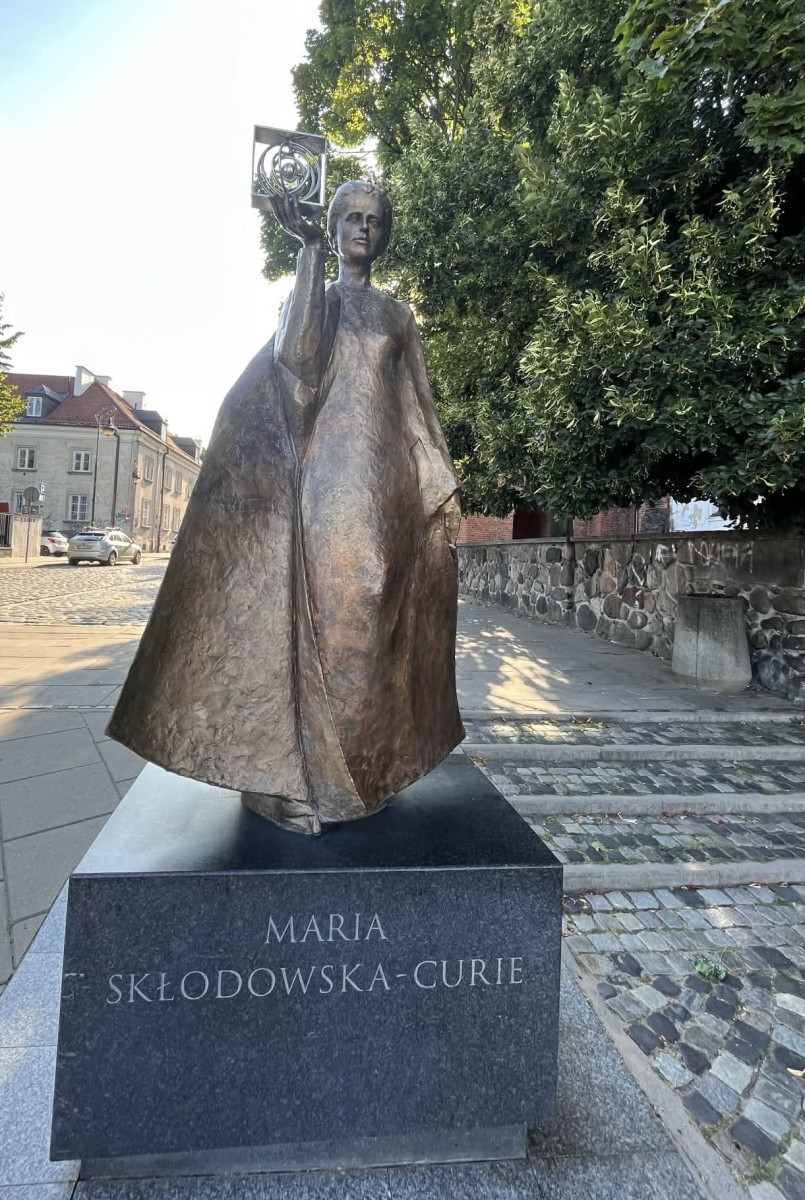
Marie Skłodowska-Curie (1867 – 1934), born in Warsaw, Poland, in 1867, was one of the greatest scientific pioneers in history and a trailblazer for women worldwide. Her life and work reshaped modern science, broke countless social and academic barriers, and left an enduring legacy that continues to inspire generations.
She achieved an extraordinary number of historic “firsts.” Maria Skłodowska-Curie was the first woman to win a Nobel Prize and remains the only person ever to win Nobel Prizes in two different scientific fields—Physics in 1903 (shared with Pierre Curie and Henri Becquerel) and Chemistry in 1911. She was also the first woman to earn a doctorate in France, the first woman to teach at the Sorbonne, and, in 1995, the first woman to be laid to rest in the Panthéon in Paris in her own right—honored for her achievements rather than her marriage.
Her scientific discoveries revolutionized the understanding of matter and energy. She pioneered research into radioactivity, a term she herself coined, and discovered two new elements: polonium, named after her homeland Poland, and radium. These discoveries opened entirely new fields of scientific inquiry and laid the foundation for major advances in medical diagnostics and cancer therapy, transforming modern medicine.
Maria Skłodowska- Curie’s contributions extended far beyond the laboratory. During World War I, she recognized the urgent need for medical imaging on the battlefield and developed mobile radiography units, later known as the “Little Curies.” Working alongside her daughter Irène, she equipped vehicles with X-ray machines, trained medical personnel, and personally drove units to the front lines. These innovations allowed doctors to locate bullets and fractures quickly, saving countless lives and dramatically improving battlefield medical care.
Her dedication to science continued after the war. In 1921, she traveled to the United States, where President Warren G. Harding presented her with a gram of radium, funded by American women. At the time, radium was extraordinarily rare and expensive, and the gesture symbolized global respect and support for her groundbreaking research.
The Curie family itself represents a unique scientific legacy. In addition to Marie and Pierre Curie, their daughter Irène Joliot-Curie and son-in-law Frédéric Joliot-Curie were awarded the Nobel Prize in Chemistry in 1935. Furthermore, Henry Richardson Labouisse Jr., the husband of Marie’s younger daughter Ève Curie, received the Nobel Peace Prize in 1965 on behalf of UNICEF. In total, five members of the Curie family were associated with Nobel Prizes—an unparalleled achievement in history. In honor of Marie and Pierre’s contributions, the chemical element curium (atomic number 96) was named after them.
Maria Skłodowska-Curie’s influence also extends deeply into global culture. Her face has appeared on more than 600 postage stamps worldwide, reflecting her universal recognition. Her life story has inspired numerous artistic works, including films such as Madame Curie (1943), starring Greer Garson, and Radioactive (2019), starring Rosamund Pike. Her legacy was further celebrated in the 2018 Korean musical Marie Curie, later translated into English and performed across Asia and Europe, culminating in a special Off West End premiere in London in 2024.
Rosa Luxemburg (1871 –1919) was a Polish-born German revolutionary and Marxist theorist, renowned for her contributions to socialist movements in both Poland and Germany. Following World War I, she became a central figure in the Spartacus Revolt, a communist uprising in Germany. However, her support for the revolt led to her capture and tragic death at the hands of counter-revolutionary forces on 15 January 1919.
Helena Rubinstein (1872–1965) —was a pioneering Polish businesswoman and visionary in the beauty industry, founder of the Helena Rubinstein Incorporated cosmetics company, one of the richest women on earth. Born in Kraków to a middle-class Jewish family, she defied expectations by rejecting an arranged marriage and emigrating to Australia in 1896 with little money and minimal English. She quickly gained popularity for her radiant complexion, selling lanolin-based creams to meet the local demand for skincare. Her entrepreneurial journey evolved from a small shop in Melbourne to luxurious salons in London (1908), Paris (1912), and New York (1914), serving wealthy and aristocratic clients. By 1917, she expanded into wholesale distribution, pioneering medicated skincare products. By World War II, her company operated on five continents, earning her a fortune estimated at $100 million. As a patron of the arts and philanthropist, she founded the Helena Rubinstein Foundation in 1953 to support museums, colleges, and institutions aiding women and children. The L’Oréal-UNESCO Women in Science Awards continue her legacy, honoring exceptional women in science. The existential philosopher Martin Buber was het cousin.
Maria Grzegorzewska (1887 –1967) was the mother of special education in Poland. She was a visionary Polish educator whose groundbreaking work laid the foundation for special education in Poland. Born in 1887, she dedicated her life to creating a system that offered children with disabilities or social challenges not only education, but also dignity, opportunity, and a sense of belonging. She is widely recognized as the founder of special education in Poland—a field she not only introduced but also transformed into a structured, academic discipline. In 1922, she established the State Institute of Special Education (Państwowy Instytut Pedagogiki Specjalnej), which became the country’s first center for training special education teachers and conducting research in the field. Grzegorzewska’s innovative approach shifted the focus from merely addressing disabilities to understanding and supporting the unique needs of each individual. Her philosophy was deeply humanistic: she believed that every person, regardless of ability, had inherent worth and the right to learn, grow, and participate in society. Her influence extended beyond Poland. From the 1930s onward, her writings, translations, and correspondence helped shape special education practices across the former Eastern Bloc, including in countries like Yugoslavia.
Maria Dąbrowska (1889 –1965) was a prominent Polish writer, novelist, essayist, journalist, and playwright. She was nominated for the Nobel Prize in Literature eleven times between 1939 and 1965, cementing her legacy as one of Poland’s most influential literary figures.She is best known for her acclaimed historical novel, Noce i dnie (Nights and Days), published between 1932 and 1934 in four volumes, which became a cornerstone of Polish literature. The novel was later adapted into a highly successful film of the same title by Jerzy Antczak in 1975. In addition to her literary achievements, Dąbrowska was celebrated for her translation of Samuel Pepys’ Diary into Polish, showcasing her linguistic skills and cultural contribution. Her work earned her numerous accolades, including the Golden Laurel of the Polish Academy of Literature in 1935.
Zofia Stryjeńska (1891–1976) —was a groundbreaking Polish artist and a key figure in Art Deco, known for her vibrant compositions that blended Polish folklore with modernist aesthetics. She worked across various mediums, including painting, graphic design, set design, and fabric design. Stryjeńska gained international recognition at the 1925 Paris Exhibition, winning multiple Grand Prix for her architectural decoration, posters, and fabrics. After World War II, Stryjeńska moved to France and Switzerland, refusing to join the communist-run Polish Writers’ Union. As a result, the government ignored her as an artist, despite widely reproducing her work without royalties. Visitors to Warsaw can for example admire her frescoes on one of the tenement houses in the Old Town. In 2021, Google celebrated her 130th birthday with a Google Doodle, recognizing her enduring legacy.
Pola Negri (1897–1987) born Barbara Apolonia Chałupiec, was one of the brightest stars of Hollywood’s silent film era and a true international trailblazer. Rising from Poland to global fame, Pola Negri became the first European actress invited to Hollywood, where she signed a groundbreaking contract with Paramount Pictures starting at $3,000 per week, an extraordinary salary at the time, increasing to $10,000 per week by 1928. Adjusted for today, that would equal several hundred thousand dollars per week, placing her among the highest-paid performers of her era.
Known for portraying mysterious femme fatale characters, Negri carried the same captivating aura off-screen. Hollywood buzzed with stories of her relationships with icons such as Charlie Chaplin and Rudolph Valentino, reinforcing her status as one of the first true celebrity personalities shaped as much by media attention as by film roles.
Over the course of her career, she appeared in more than 60 films across both the silent and sound eras, earned a star on the Hollywood Walk of Fame, and was among the first 11 stars in Hollywood history to place her hand and footprints at Grauman’s Chinese Theatre, two distinct honors recognizing her lasting impact on cinema. Her final screen appearance came in 1964 in The Moon-Spinners. During the London press tour, she famously arrived at a press conference with a cheetah on a leash, demonstrating her instinctive understanding of publicity and spectacle decades before personal branding became a strategy.
She was one of the earliest examples of a global entertainment brand, commanding record-breaking pay, transcending borders, mastering media attention, and shaping the image of the modern international movie star.
Tamara Łempicka (1898–1980) —was a pioneering Polish Art Deco painter, renowned for her bold, glamorous style that fused mature Cubism with Neoclassical aesthetics. Born in Warsaw and educated in Paris, she became famous for her sophisticated portraits of wealthy aristocrats and celebrities, capturing the elegance and modernity of the Art Deco era. Her iconic Self-Portrait in a Green Bugatti (1925), commissioned by Die Dame magazine, became a symbol of female independence, while Portrait of Marjorie Ferry (1932) sold for over $21 million at Christie’s in 2020. Lempicka’s vibrant and tumultuous life mirrored her art—fleeing Russia after the 1917 Revolution, escaping Europe in 1939, and living a life of fame, scandal, and numerous romances. Her works are highly prized by collectors, including Madonna, Jack Nicholson, Barbra Streisand, and Wolfgang Joop. Madonna, in particular, has featured Lempicka’s art in several of her music videos, such as “Vogue” (1990), and used her paintings in concert tours. Lempicka’s career reached its peak in the 1930s, when she painted portraits of King Alfonso XIII of Spain and Queen Elizabeth of Greece, while museums began collecting her works. She was honored with a Google Doodle in 2018 to celebrate her 120th birthday. Her influence extends beyond art—Tamara, a stage play based on her life, ran in Los Angeles for 11 years, and her story was fictionalized in Ellis Avery’s novel The Last Nude, which won the 2013 Stonewall Book Award.
Irena Krzywicka (1899–1994) —was a pioneering Polish feminist, writer, translator, and women’s rights activist, known for her bold advocacy of sexual education, contraception, and planned parenthood. During the interwar period, she became one of the most prominent feminists in Poland, challenging societal norms by openly discussing taboo topics such as abortion, women’s sexuality, and homosexuality — subjects considered scandalous at the time. In collaboration with Tadeusz Boy-Żeleński, a renowned writer, poet, critic, and translator, Krzywicka co-founded a family planning clinic in Warsaw, offering free information on contraception and reproductive health. Her unwavering efforts to promote sexual education made her the most iconic feminist of pre-war Poland, leaving a lasting legacy in the fight for women’s rights.
Maria Wittek (1899–1997) —was a trailblazing Polish military leader and the first woman in Poland to achieve the rank of brigadier general. Born and raised in the Russian partition of Poland, she became the first female student in the mathematics department at Kiev University, where she also joined the clandestine Polska Organizacja Wojskowa (Polish Military Organization) and completed NCO training. In 1919, she fought alongside Polish forces against the Bolsheviks in Ukraine, and in 1920, as a member of the Women’s Volunteers, she bravely defended Lwów (now Lviv), earning the prestigious Virtuti Militari — Poland’s highest military honor. During the 1939 Invasion of Poland, Wittek commanded the Women’s Military Assistance Battalions. She later joined the underground ZWZ (which became the Home Army) and fought in the Warsaw Uprising, eventually reaching the rank of lieutenant colonel. After the war, she briefly returned to her post as head of the women’s division at the Institute of Physical Education and Military Training, but in 1949 she was arrested by the communist authorities and spent several months in prison. Upon her release, she lived modestly, working at a newspaper kiosk. Despite these hardships, she founded the “Commission for the History of Women” to document the contributions of women in Poland’s history.With the fall of communism, President Lech Wałęsa promoted her to brigadier general on May 2, 1991, making her the first Polish woman to hold this rank. She remained unmarried throughout her life, dedicated to her country and the cause of women’s involvement in military service. On the 10th anniversary of her death, April 19, 2007, a life-size bronze monument honoring her legacy was unveiled at the Polish Army Museum in Warsaw.
Halina Konopacka (1900 –1989) was a trailblazing Polish athlete and the first Olympic gold medalist in Poland’s history. In 1928, at the Amsterdam Olympics—the first to allow women in athletic events—Konopacka won gold in the discus throw, breaking her own world record with a throw of 39.62 meters. Konopacka’s Olympic victory, achieved in front of 20,000 spectators, was more than a personal triumph; it marked a historic moment for Polish sport as the national anthem played in celebration. Beyond sports, Konopacka was a multilingual intellectual, poet, and artist. She published her first book of poetry in 1929, and after retiring from competition in 1931, remained active in skiing, tennis, and car racing. In 1928, she married Colonel Ignacy Matuszewski, a prominent Polish official. During World War II, she helped him transport the Polish National Bank’s gold reserves to France to support the government-in-exile. When France surrendered, the couple went to the United States, where they chose to remain after Poland was absorbed into the Eastern Bloc. In the U.S., Konopacka pursued various passions—founding a ski school, designing clothing, running a boutique, and later becoming a painter after graduating from art college at age 60. She was married three times and outlived all her husbands. In 1989, shortly before her death, she was posthumously honored with Poland’s Silver Cross of Merit. Her ashes were returned to Warsaw and laid to rest in her family’s grave at Bródno Cemetery.
Hanka Ordonówna (1902–1950) —was a renowned Polish singer, dancer, and actress. She became famous for her iconic rendition of the song “Miłość Ci wszystko wybaczy,” (Love will forgive you everything) a classic that remains beloved by many. Ordonówna performed on numerous stages, not only in Poland but also in Germany and France. In 1933, she married Michał Tyszkiewicz, a composer who wrote many of her songs. Her career, which started in cabaret, also saw her performing on horseback in circus revues. Before the outbreak of World War II, she toured the United States but returned to Poland in the fall of 1939. On November 1, 1939, she protested the screening of a Nazi film about the occupation of Warsaw in Polish cinemas, which led to her arrest by the Gestapo and imprisonment at Pawiak. She was released in April 1940 after her husband intervened. After the German-Soviet war broke out she was arrested and sent to a labor camp in Uzbekistan. Even in exile, she continued to perform, joining other Polish artists and assisting Polish orphans, helping them travel from Bombay, India, to Beirut, Lebanon. Despite being severely ill with tuberculosis, she performed over 50 concerts, some in difficult conditions, for Polish soldiers during the war.
Faustyna Kowalska (1905–1938) —was a Polish nun and mystic. Throughout her life, she claimed to have experienced visions of Jesus and engaged in conversations with him. These mystical experiences led to the establishment of the Roman Catholic Divine Mercy devotion, and she became known as the ‘Apostle of Divine Mercy.’ Inspired by her detailed accounts, the iconic Divine Mercy image was created Faustyna herself couldn’t paint, so she worked with artists to depict the vision she received, leading to several known versions. She was canonized as a saint in 2000.
Alina Centkiewicz (1907 -1993) —was the first Polish woman and the sixth woman in the world to set foot on Antarctica. (in 1958) She was a writer and author of travel books, mainly focused on polar regions, which she co-wrote with her husband, Czesław Centkiewicz.
Janina Antonina Lewandowska(1908-1940) Europe’s first woman to parachute from an altitude of five kilometres and the first woman pilot in the Polish Air Forces. She was a glider and airplane pilot, a lieutenant pilot of the Polish Army of the Second Republic of Poland and the only female soldier killed in Katyń as part of the Katyń crime. She was the daughter of General Józef Dowbor-Muśnicki, renowned for his role as the supreme commander during the Greater Poland Uprising, and Agnieszka, née Korsuńska. On September 22, 1939, she was captured by Soviet forces. On the same day, a victory parade by both the Wehrmacht and the Red Army took place in Brest. Janina was initially sent to the camp at Ostaszków and later transferred to Kozielsk. On her 32nd birthday, she was executed by the NKVD, shot in the back of the head. She was buried in a mass grave alongside other victims of the Soviet massacre. Her name appears on the death list of prisoners from Kozielsk, numbered 0401, position 53, dated April 20, 1940. Her younger sister Agnieszka Dowbor-Muśnicka (1919-1940) continued the family tradition of Polish resistance by joining the Armia Krajowa (Home Army).During the occupation, she became active in the underground military organization “Wilki” (“Wolves”). On April 25, 1940, members of her group with Agnieszka were arrested and imprisoned in Pawiak prison. They were tortured, and ultimately sentenced to death. She was one of the 362 people who were executed and buried in mass, unmarked graves in Palmiry on June 20/21, 1940. Like Janina, she was shot in the back of the head and buried in a shallow grave—one killed by the Germans, the other by their then-allies, the Soviets.
Maria Krystyna Janina Skarbek (1908 –1952), better known as Christine Granville, was a singular figure in World War II espionage—brave, unconventional, and unforgettable. As the first female field agent of the British Special Operations Executive (SOE) and the longest-serving woman in that role, Skarbek rewrote the rules of wartime intelligence. What made her truly exceptional wasn’t just her daring missions behind enemy lines in Nazi-occupied Poland and France, but the way she carried them out—with boldness, charisma, and razor-sharp instincts. Nicknamed “Churchill’s favourite spy,” she was known for her glamour, quick thinking, and ability to manipulate danger to her advantage. Her success and ingenuity directly influenced SOE’s decision to recruit more women agents—transforming the landscape of wartime espionage. She operated under the alias Christine Granville from 1941, a name she later adopted legally when she became a British citizen in 1946. For her wartime service, Skarbek was awarded the George Medal, the Croix de Guerre from France, and was made an Officer of the Order of the British Empire (OBE)—a level of distinction rare among her female peers. Tragically, she was murdered in London in 1952 by a rejected suitor, a grim end to a life defined by courage. Her legacy, however, lives on—not only in the honors she received but in the stories that followed her. Some even believe she inspired Ian Fleming’s iconic Bond girl, Vesper Lynd.
Antonina Maria Żabińska (née Erdman, 18 July 1908 – 19 March 1971) was a Polish writer and quiet heroine of World War II, whose courage and compassion helped save almost 300 lives of Jewish people. Alongside her husband, Jan Żabiński, director of the Warsaw Zoo, Antonina used the zoo’s abandoned animal enclosures to shelter Jews fleeing the Warsaw Ghetto. With extraordinary bravery, the Żabińskis transformed empty cages, pens, and stalls into temporary hiding places on the eastern bank of the Vistula River. Over three years, they helped hundreds of Jews find refuge. Their own villa on the zoo grounds also became a safe haven, sheltering nearly a dozen people at a time. Their young son, Ryszard, played a vital role—caring for those in hiding with a maturity well beyond his years. Antonina’s empathy, calm under pressure, and ability to use music and storytelling to comfort those in fear made her a lifeline during terrifying times. Her wartime diaries formed the basis for Diane Ackerman’s bestselling 2007 book, The Zookeeper’s Wife, which brought Antonina’s story to a global audience. A film adaptation followed in 2017, with Jessica Chastain portraying Antonina. In recognition of their extraordinary efforts, Antonina and Jan were named Righteous Among the Nations by Yad Vashem in 1965. A tree was planted in their honor in 1968 at the Yad Vashem memorial. In 2008, Antonina was posthumously awarded the Commander’s Cross of the Order of Polonia Restituta, one of Poland’s highest honors.
Elżbieta Zawacka (1909 –2009) —was a Polish freedom fighter, Special Operations Executive (SOE) agent, and university professor. Known by her wartime codename “Zo,” she was the only woman in the elite Cichociemni (“Silent Unseen”) unit of the Polish underground. She served as a courier for the Polish Home Army, courageously transporting letters and classified documents between Nazi-occupied Poland and the Polish government-in-exile in London, with a regular route running through Warsaw, Berlin, Sweden, and London. In addition to her own missions, she organized routes for other Home Army couriers and participated in the 1944 Warsaw Uprising. After the war, Zawacka pursued an academic career and was later promoted to brigadier general of the Polish Land Forces, becoming the second woman to hold this rank after Maria Wittek. President Lech Kaczyński awarded her this honor on 3 May 2006.
Irena Sendlerowa (1910–2008) —was a courageous humanitarian and social worker who played a pivotal role in saving approximately 2,500 Jewish children during World War II. A nurse by profession, she was just 29 years old when the Germans began the occupation of Warsaw. She became an active member of Żegota, the Polish underground resistance organization dedicated to aiding Jews. Through her remarkable efforts, she smuggled children out of the Warsaw Ghetto, often risking her own life. She forged documents, arranged safe houses, and utilized her network with orphanages to ensure the children were protected from the horrors of Nazi occupation. In 1943, she was arrested by the Gestapo, tortured, and sentenced to death. However, thanks to the intervention of the Polish underground, she was rescued before the sentence could be carried out. Despite the dangers she faced, her dedication never wavered. In 1965, she was honored by Yad Vashem as one of the “Righteous Among the Nations,” a title bestowed on those who risked their lives to save Jews during the Holocaust. Her bravery and compassion are remembered as a testament to the power of one individual’s actions in the face of oppression and violence.
Anna Leska-Daab (1910–1998) — was a trailblazing Polish aviator, certified to fly gliders, balloons, and aeroplanes. She made history as one of the first two Polish women to join the British Air Transport Auxiliary during World War II, alongside Stefania Wojtulanis-Karpińska. Known for her dedication and skill, Leska played an essential role in ferrying military aircraft for the Allies. Her contributions were recognized in 2015 when her portrait was featured in the Imperial War Museum’s exhibition “Lee Miller, A Woman’s War,” which celebrated the vital role women played during wartime.
Zofia Rydet (1911 –1997) — was a renowned Polish photographer, widely acclaimed for her monumental project “Sociological Record” (Zapis Socjologiczny), which sought to document the lives of ordinary people across Poland. She began this ambitious project in 1978 at the age of 67 and continued until her death in 1997, capturing nearly 20,000 photographs. Rydet’s photographs primarily consist of intimate portraits of individuals, families, and communities, often showing children, adults, couples, and the elderly within the context of their homes and surroundings. Known for her direct, straightforward approach, she employed a wide-angle lens and flash to capture her subjects in a natural, unposed manner. Her work focused particularly on the rural regions of Podhale, Upper Silesia, and Suwałki, documenting everyday life and the cultural nuances of Polish households. The black-and-white images of Sociological Record are an invaluable reflection of Polish society in the late 20th century, offering insight into the customs, traditions, and personal stories of ordinary citizens. Her work can be found amongst the most important Polish collections, including the National Museum in Wrocław, the Muzeum Sztuki in Łódź, the Museum of Photography in Cracow, the Silesian Museum in Katowice, as well as the Museum of Modern Art in New York, the Centre Georges Pompidou in Paris, The Museum of Modern Art in Kioto, and the National Museum of Photography, Film and Television in Bradford.
Stefania Cecylia Wojtulanis-Karpińska (1912–2005) — waspioneering Polish aviator and military pilot. A sports pilot during the interwar period, she later served as a Captain in the Polish Air Force. During World War II, she became one of the first two Polish women alongside Anna Leska to join the British Air Transport Auxiliary (ATA), using the name Barbara Wojtulanis. After the war, she married Polish Air Force General Stanisław Karpiński in 1946 and settled in Los Angeles in 1958, where she became active in Polish-American communities. There, she studied computer programming and worked in data processing, while also contributing to veteran organizations and supporting Polish cultural institutions. Stefania was also the president of the “Wings of the Pacific” Polish Airmen’s Association in California, advocating for Polish heritage and veterans.
Seweryna Szmaglewska (1916 –1992) — was a Polish writer, renowned for her works for both children and adults. She was also a survivor of the Auschwitz-Birkenau concentration camp during World War II and as a survivor of Nazi camps she was one of two Poles to testify at the Nuremberg Trials in February 1946, alongside Samuel Rajzman. Her testimony focused on the atrocities committed against children at Auschwitz. Her novels Czarne Stopy (Black Feet) and Dymy nad Birkenau (Smoke over Birkenau) are mandatory reading in Polish schools. Between 1942 and 1945, Szmaglewska was imprisoned in Auschwitz-Birkenau, following two months in the prisons of Piotrków and Częstochowa. In 1945, she managed to escape during a death march to the Gross-Rosen camp. After the war, Szmaglewska became a successful writer. Initially, she wrote about her wartime experiences in books such as Dymy nad Birkenau and Łączy nas gniew (Anger Unites Us), as well as Niewinni w Norymberdze (The Innocents at Nuremberg). Over time, she expanded her literary work to include novels for young readers. Her most famous book, Czarne Stopy (Black Feet), published in 1960, tells the story of Polish boy scouts and was adapted into a film in 1986. A continuation of the novel, Nowy ślad Czarnych Stóp (A New Trail of Black Feet), was published in 1973. Her books have been translated into several languages, including English and French.In 1946, Szmaglewska married Witold Wiśniewski, whom she had met earlier in Auschwitz. They had two sons: Witold and Jacek.
Irena Kempówna- Zabiełło (1920-2002) — was a renowned Polish glider pilot and double world record holder. She began gliding in 1936 and took part in the Warsaw Uprising during World War II. In June and July 1945, she completed an instructor course at the Civil School of Pilots and Mechanics and subsequently led similar courses herself. Between 1948 and 1951, Kempówna set numerous Polish records in flight duration, distance, and maximum altitude. She also set two women’s world records: on June 10, 1949, she achieved a speed record of 50 km/h on a 100 km triangular route using the IS-1 Sęp glider and on November 12, 1950, she set another world record for maximum altitude of 4,963 meters in a two-seater glider Żuraw, alongside Lucyna Wlazło. On November 1, 1957, she became the director of the Gliding School of the Polish Aero Club in Strzyżewice, near Leszno, which was later renamed the Gliding Center of the Polish Aero Club. In 1959, the Fédération Aéronautique Internationale (FAI) awarded her the Paul Tissandier Diploma for her exceptional contributions and achievements in sport aviation. In 1966, she moved to Switzerland with her husband, where she worked as a flight simulator instructor for Swissair.
Jadwiga Piłsudska-Jaraczewska (1920–2014) — the daughter of Poland’s legendary leader Józef Piłsudski, became an accomplished pilot during World War II. After obtaining her pilot’s license, she joined the British Air Transport Auxiliary in 1942, where she flew unarmed military aircraft over wartime Britain, alongside other Polish women like Anna Leska and Barbara Wojtulanis. Following the war, due to the political situation in Poland, Jadwiga chose to remain in England as a political émigré, never accepting British citizenship. She used a Nansen passport to travel, which allowed her to move freely, except to Poland. She later returned to Warsaw in 1990 after the collapse of the communist regime.
Michalina Anna Wisłocka (1921–2005) — was a pioneering Polish gynecologist, sexologist, and author of the groundbreaking book Sztuka Kochania (The Art of Loving), published in 1976. It was the first comprehensive guide to sexual life in a communist country and became an instant bestseller, with over 7 million copies sold, significantly contributing to greater openness and public discourse about sexuality in Poland. Wisłocka co-founded the Society of Sensible Maternity, where she worked on infertility treatment and birth control, advocating for women’s reproductive health. She also served as the head of Poland’s first Dispensary of Sensible Maternity at the Institute of Mother and Child in Warsaw. In the 1970s, she led the Cytodiagnostic Laboratory of the Family Planning Society, promoting family planning and women’s health. Beyond her medical achievements, Wisłocka is remembered for breaking societal taboos around sexuality and empowering women with knowledge about their bodies. Notably, her niece was Ewa Braun, an Academy Award-winning set decorator and costume designer.
Wisława Szymborska (1923–2012) —was a Polish poet, essayist, and translator who won the Nobel Prize in Literature in 1996. She debuted in 1945 with a poem titled Looking for Words, marking the beginning of a lifelong exploration of language and meaning. Szymborska published 16 volumes of poetry throughout her career, celebrated for their deep philosophical insight, humor, and irony. The Nobel Committee awarded her the prize for her poems, describing them as “an answer to life, a way of living and working with words.” Her renowned collections include Calling Out to Yeti (1957), No End of Fun (1967), and The End and the Beginning (1993)
Anna Walentynowicz (née Lubczyk, 1929 –2010) was a Polish trade unionist whose courage and defiance helped spark a movement that would change the course of history. Often called the “mother of independent Poland,” she was a co-founder of Solidarity (Solidarność), the first independent trade union recognized in the Eastern Bloc.Her dismissal from her job as a welder at the Lenin Shipyard in Gdańsk in August 1980—just five months before her retirement—ignited a massive strike that quickly spread along Poland’s Baltic coast. Workers rallied around the call to “Bring Anna Walentynowicz back to work!” and formed the Interfactory Strike Committee (MKS). That committee soon evolved into Solidarity, a movement that would go on to shake the foundations of communist rule in Eastern Europe. Within a month, over a million workers had joined the strike, making it the largest labor uprising in the region’s history.Walentynowicz became a symbol of resistance and working-class strength. Tragically, she was among the passengers killed in the 2010 Polish Air Force crash near Smolensk, Russia, which also claimed the lives of President Lech Kaczyński, his wife, and dozens of Poland’s top military and political leaders. Her legacy endures: in 2006, she was awarded Poland’s highest civilian honor, the Order of the White Eagle, and in 2020, Time magazine named her one of the 100 Women of the Year, recognizing her as a defining figure of 1980 and a catalyst for global change. Anna Walentynowicz stood for dignity, justice, and the unstoppable force of ordinary people fighting for their rights.
Magdalena Abakanowicz (1930–2017) —was a renowned Polish sculptor and fiber artist, celebrated for her large-scale installations exploring identity, humanity, and society. She revolutionized textile art with her three-dimensional Abakans in the 1960s, which gained international acclaim, including a spot in the Wall Hangings exhibition at New York’s Museum of Modern Art (MoMA). Her powerful humanoid figures and outdoor sculptures are displayed in prestigious institutions such as MoMA, the Hirshhorn Museum, and the National Gallery of Art in Washington, D.C. Abakanowicz received numerous accolades, including the Grand Prix of São Paulo Biennale (1965), the Herder Prize (1979), and the Lifetime Achievement in Contemporary Sculpture Award (2005). In 2023, she was honored with a Google Doodle, reflecting her enduring impact on modern art.
Wanda Rutkiewicz (1943–1992) —was a legendary mountaineer who made history as the first European woman to summit Mount Everest and the first woman to climb K2, two of the most challenging and dangerous peaks in the world. Her remarkable feats broke barriers in the male-dominated world of high-altitude climbing. In 1992, while attempting to climb Kangchenjunga, Rutkiewicz, at 49 years old, was last seen alive by Mexican climber Carlos Carsolio. It remains unclear whether she reached the summit of Kangchenjunga. Had she done so, she would have become the first woman to conquer the world’s three highest mountains. Tragically, her body has never been found. On 16 October 2019, to honor her legacy, Rutkiewicz was featured in a Google Doodle marking the 41st anniversary of her ascent of Mount Everest. The Doodle depicted her climbing snowy peaks with a railing rope. In October 2021, the Polish Parliament passed a resolution to commemorate the 30th anniversary of her death, designating 2022 as the “Year of Wanda Rutkiewicz.”Rutkiewicz’s groundbreaking achievements in mountaineering not only earned her international acclaim but also paved the way for future generations of female climbers. She remains a trailblazer and one of Poland’s most heroic and inspirational figures in the world of extreme sports.
Simona Gabriela Kossak (1943 –2007) — was a pioneering Polish biologist, ecologist, and professor of forest sciences, best known for her dedication to preserving the remnants of natural ecosystems in Poland. Kossak’s work primarily focused on the behavioral ecology of mammals, and she was affectionately known as a “zoo-psychologist” for her unique approach to studying animals. Her commitment to conservation led her to spend over 30 years living in a remote hut in the Białowieża wilderness, Europe’s oldest primeval forest, located on the border between Poland and Belarus. Kossak’s life and work were so intertwined with nature that she became a part of the forest itself, forming close bonds with the wild animals. It was said that she could communicate with them, earning her the nickname “the witch” from locals who marveled at her ability to connect with the animals she cared for. Her home was anything but conventional—she shared it with a tamed boar, and a lynx often slept in her bed. One of her more infamous companions was a crow, known for its mischievous behavior of stealing gold and attacking bicyclists. Simona Kossak was not only an accomplished scientist but also an activist who fought tirelessly to protect the Białowieża Forest and its unique ecosystem. Her extraordinary life and work were the inspiration for a 2024 biographical drama film, directed by Adrian Panek, which premiered at the 24th New Horizons International Film Festival.
Urszula Dudziak (b. 1943) is a pioneer of vocal innovation, the world’s first singer to use transducers and live vocal looping, Urszula Dudziak revolutionized jazz vocals with her inventive approach and extraordinary five-octave range. Over the course of her career, she has recorded more than 50 albums, blending improvisation, electronics, and experimentation to expand the expressive possibilities of the human voice.She has collaborated with some of the greatest names in contemporary music, including Sting, Archie Shepp, Lester Bowie, and was part of the avant-garde vocal group Vocal Summit, alongside Jay Clayton, Jeanne Lee, Bobby McFerrin, Norma Winstone, and Lauren Newton. Dudziak has performed in nearly every corner of the world—from Carnegie Hall in New York to the Newport Jazz Festival, and across Europe, Asia, and the Americas. In 1972, her album Newborn Light received a rare five-star review from the prestigious American magazine Down Beat. In 1979, the Los Angeles Times named her Singer of the Year. Her hit song “Papaya” became a global phenomenon, bringing her voice to audiences far beyond the jazz scene. In recognition of her contributions to music and culture, Dudziak was awarded the Knight’s Cross of the Order of Polonia Restituta by President Lech Kaczyński on 11 November 2009. A fearless innovator and international icon, Urszula Dudziak remains one of Poland’s most celebrated musical artists.
Ewa Braun (b. 1944) — is a renowned Polish set decorator, costume designer, and production designer, best known for her outstanding contributions to cinema. With a career spanning since the 1960s, she has worked on numerous acclaimed films, earning international recognition for her meticulous attention to detail and artistic vision.Her most notable achievement came with Steven Spielberg’s Schindler’s List (1993), where she won an Academy Award for Best Art Direction/Set Decoration, shared with Allan Starski. This historic win highlighted her exceptional ability to create powerful, authentic environments. Other prominent films include Europa, Europa (1990) by Agnieszka Holland, and Holy Week (1995) by Andrzej Wajda. Ewa Braun remains celebrated for her ability to bring historical accuracy and emotional depth to film sets, making her one of Poland’s most distinguished figures in production design.
Irena Szewińska (1946–2018) —one of Poland’s greatest athletes, was a trailblazing sprinter who dominated track and field for nearly two decades. She won seven Olympic medals, including three golds, and remains the only athlete in history, male or female, to hold world records in the 100m, 200m, and 400m events. Her dominance on the track was unmatched, as she was ranked number 1 in the world seven times in the 200m, four times in the 400m, and twice in the 100m. She also earned accolades such as the 1974 United Press International Female Athlete of the Year and twice won the European Sportsperson of the Year (1966 and 1974). After retiring, Szewińska transitioned to sports administration. In 1998, she became a member of the International Olympic Committee and served as the president of the Polish Athletic Association from 1997 to 2009. In 2005, she was elected to the IAAF Council as one of the first women to hold such a position. A member of both the International Jewish Sports Hall of Fame and the IAAF Hall of Fame, Szewińska’s legacy extends far beyond athletics.
Hanna Suchocka (b. 1946) —made history as the first female Prime Minister of Poland, serving from 1992 to 1993 under President Lech Wałęsa, preceding Ewa Kopacz and Beata Szydło. She was also the 14th woman worldwide to hold such a position. A distinguished lawyer and professor at Adam Mickiewicz University in Poznań, she chaired the Constitutional Law Department and served as First Vice-President and later Honorary President of the Venice Commission. In 1994, she co-founded the Liberty Union party, becoming a key figure in Poland’s liberal and social-democratic movement. She is a member of the Council of Women World Leaders, promoting global collective action on critical issues for women. In 2014, Pope Francis appointed her to the Pontifical Commission for the Protection of Minors, highlighting her lifelong commitment to public service.
Agnieszka Holland (b. 1948) — is an acclaimed film director and screenwriter nominated 3 times for Oscars and winner of many prestigious film awards. Her films often tackle difficult and politically charged subjects, shedding light on themes of human rights, identity, and morality. Holland’s work has earned her numerous awards and recognition at international film festivals. She was Nominated for the Oscar in 1985 for Angry Harvest, in 1990 for Europa, Europa and 2012 for In Darkness. She won the Golden Globe Award for Best Foreign Language Film for Europa Europa (1990) and the César Award for Best Foreign Film for In Darkness (2011). Holland has also been nominated for Academy Awards and BAFTA Awards, further solidifying her reputation as one of the most respected filmmakers globally.
Olga Tokarczuk (b. 1962) —a Nobel Prize-winning author (2018), is celebrated for her philosophical depth and exploration of identity, history, and human nature. Her works, translated into more than 50 languages, include Flights and The Books of Jacob, a monumental historical epic. Tokarczuk’s unique style connects past and present, offering solutions to modern dilemmas through historical context. Her Nobel lecture, The Tender Narrator, remains a profound reflection on the human condition and the world. Her writing is known for its intricate narratives, blending fiction with deep philosophical insights, making her one of the most influential voices in contemporary literature. On March 25th, Sorbonne University awarded her the title of Doctor Honoris Causa.
Izabella Scorupco (b. 1970) —is an actress and model, best known for her role as Bond girl Natalya Simonova in GoldenEye. Scorupco gained worldwide recognition for her portrayal of the brilliant and strong-willed Natalya in the 1995 James Bond film. She has appeared in various films and television series, maintaining a successful career in both acting and modeling.
Joanna Krupa (b. 1979) —is a model, actress, and television presenter. At the age of five, she and her family moved to the United States, settling in Lombard, Illinois. Joanna’s big break came when she graced the cover of Maxim in the Netherlands, which propelled her into the spotlight. She has since appeared on the covers of several major publications, including Playboy, FHM, Ocean Drive, Inside Sport, Stuff, and Steppin’ Out. Krupa is also known for her roles in films and TV shows, including Planet of the Apes (2001), CSI: Crime Scene Investigation (2000), and The Underground Comedy Movie (1999). Beyond her career in entertainment, she is a passionate advocate for animal rights, using her platform to raise awareness on important issues.
Justyna Kowalczyk-Tekieli (b. 1983) — cross-country skiing legend, two-time Olympic gold medalist, and multiple-time World Cup winner. Kowalczyk became one of Poland’s most successful Olympians by winning gold in the 2010 Vancouver Olympics (30 km freestyle) and the 2014 Sochi Olympics (10 km classical). Known for her fierce determination, she has also secured numerous World Cup victories and prestigious medals, solidifying her legacy as one of the greatest cross-country skiers of all time.
Otylia Jędrzejczak (b. 1983) — olympic champion swimmer, specializing in butterfly events, and a former world record holder. Jędrzejczak made history by winning a gold medal in the 200m butterfly at the 2004 Athens Olympics, along with a silver medal in the 100m butterfly. Throughout her career, she earned numerous world and European titles and set multiple world records in butterfly events. She became a national hero in Poland due to her impressive achievements and resilience, and she remains one of the most successful swimmers in Polish history.
Anja Rubik (b. 1983) — Anja Rubik is a globally acclaimed fashion model, celebrated for her collaborations with top designers and her appearances on the covers of prestigious magazines. Known for her striking beauty and distinctive sense of style, she has become one of the most sought-after figures in the fashion industry. Over the course of her career, Rubik has worked with legendary fashion houses such as Chanel, Gucci, and Valentino, and has graced the covers of renowned publications including Vogue, Harper’s Bazaar, and Elle. She was also one of Karl Lagerfeld’s most iconic muses. Beyond modeling, Rubik is a passionate advocate for women’s rights and an outspoken supporter of the LGBT+ community in Poland. She is the founder of SEXEDpl, a groundbreaking foundation dedicated to promoting comprehensive sex education in Poland. As an activist and public speaker, she plays a pivotal role in advancing social equality and empowering marginalized communities. Rubik continues to balance her influential career with her activism, living and working between New York City, Paris, and Warsaw.
Anita Włodarczyk (b. 1985) — is a three-time Olympic gold medalist and world record holder in the women’s hammer throw. Włodarczyk has made an indelible impact on the world of athletics, becoming one of the most successful female hammer throwers in history. Her dominance in the sport has earned her numerous accolades and firmly established her as one of Poland’s greatest athletes.
Iga Świątek (b. 2001) is a Polish tennis superstar best known for making history in July 2025 as Poland’s first Wimbledon singles champion, defeating Amanda Anisimova 6‑0, 6‑0 in the final—a remarkable “double bagel” victory. She first rose to global prominence in 2020 when she won the French Open, becoming the first Polish player to win a Grand Slam singles title and the youngest female French Open champion in over 20 years. Following that breakthrough, Świątek delivered a string of dominant performances across all surfaces, including multiple French Open titles (2020, 2022, 2023, 2024), a US Open victory (2022), and her first Cincinnati Open title in 2025, where she claimed her 11th WTA 1000 crown without dropping a set.
She ascended to world No. 1 in the WTA rankings in 2022 and has consistently remained among the tour’s elite, currently ranked No. 2 as of mid‑August 2025. Świątek has now joined the elite group of women in the Open Era to win Grand Slam singles titles on all three surfaces—clay, hard, and grass. Her game is defined by powerful baseline play, mental toughness, and tactical variety. Świątek continues to be a global tennis icon and proudly represents Poland on the international stage, heading into the 2025 U.S. Open as one of the tournament favorites.
photo: Maria Skłodowska-Curie statue in Warsaw ©Beata Bruggeman-Sekowska