


Sixty years ago, Konstanty Rokicki, a Polish Consul, who saved Dutch Jews during the Holocaust, died.

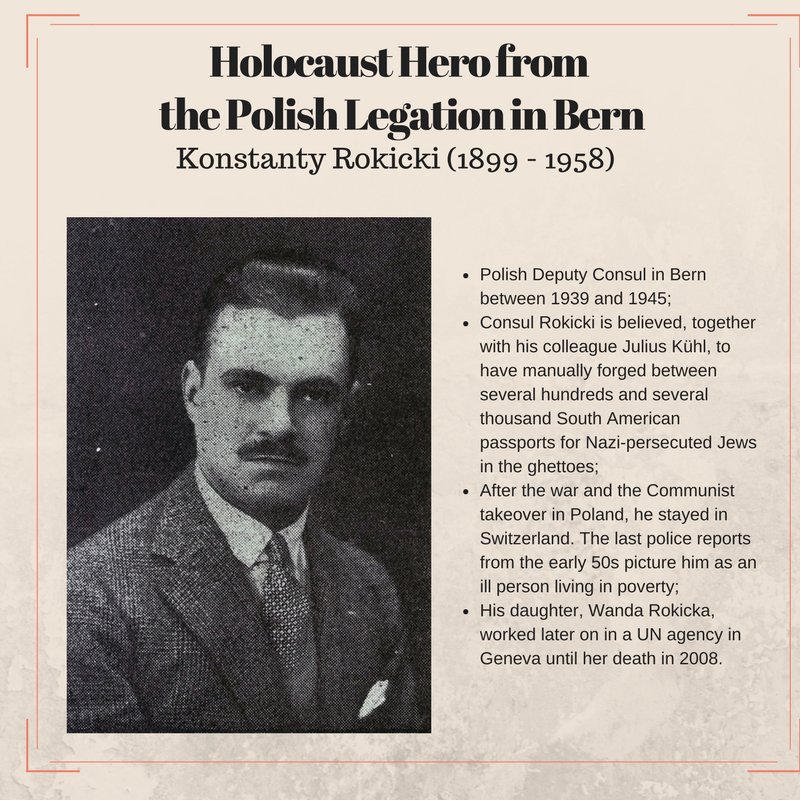
This Wednesday, July 18, marks the 60th anniversary of the death of Konstanty Rokicki (1899-1958), a Polish consul from Bern who during the Holocaust fabricated Paraguay passports, saving several hundred Jews from death, including at least 136 citizens of the Netherlands. These passports were sent to the camps in Westerbork and Bergen-Belsen and protected from deportation to German extermination camps in occupied Poland.
According to the Polish Embassy in Bern, Rokicki and his Jewish colleague Juliusz Kühl contributed to the creation of over 1,000 false passports for over 2,200 people. On the documents there are entire families with children. About one-tenth of all fake “Paraguayans” are the Dutch. The survivors thanks to Rokicki’s passports include Aron Schuster, later Chief Rabbi of Amsterdam, as well as Hanna “Hannelie” Pick-Goslar, a friend of Anne Frank mentioned in her memoirs, later rabbis, university professors, journalists and members of the Dutch elite. The Embassy in Bern has recreated a full list of the names of the Survivors, on which there are at least a dozen people living to this day.
“There are probably more Dutch survivors. We managed to determine the fate of only about 1/3 of passport holders of Paraguay, “said Ambassador of the Republic of Poland in Bern, Jakub Kumoch. He also added that the list of passport holders of Honduras, Bolivia, Haiti and other countries, bought from their honorary consuls, was underway. Probably there are the names of the next Dutch survivors on them.’’
Rokicki and Kühl operated with permission and knowledge, and probably at the command of Aleksandra Ładoś, in the years 1940-45 the ambassador representing the Polish government in exile in Bern. Also deputy Ładosia, Stefan Ryniewicz, participated in the illegal activity. All four diplomats acted in consultation with representatives of Jewish organizations. They were buying blank passports from Latin American honorary consuls and filling them with the names of Jews staying in ghettos and camps in occupied Poland and the Netherlands. Lists with names were prepared by a representative of the World Jewish Congress (WJC) in Geneva, Abraham Silberschein and by the leader of the Swiss branch Agudath Yisrael, Chaim Eiss. Such passports saved a part of the owners from death in the German extermination camps, and in 1945 they allowed for the exchange of some of them for the interned by the Allies Germans.
“Initially, the Polish Legation and its Jewish partners worked to save our Polish Jews, but in 1943, among the fabricated passports, passports for Dutchmen and stateless persons, former citizens of the German Reich, deprived of citizenship by the Nazis began to appear,” said Ambassador Kumoch. He expressed his gratitude to the Dutch Survivors and Holocaust researchers for help in determining the fate of Dutch passport holders. “The knowledge of the heroic activity of our predecessors reached us primarily thanks to the members of the Jewish community. The communist regime in Poland has never been interested in this history “- he added.
Almost all Paraguayan passports found are written in the style of the handwriting of Konstanty Rokicki’s, a Polish consular officer, while in the archives of Yad Vashem there is extensive correspondence between the Polish consul and Abraham Silberschein regarding the production of individual passports.
Konstanty Rokicki remained after the war in Switzerland, where he died in 1958, leaving no memories. He was buried at the cemetery in Lucerne in the section for the poor. A note from the Swiss police from 1946 has been preserved, in which Rokicki as the applicant for permanent residence was accused of taking part in the “illegal passport scandal”. The police, however, suggested issuing permission for permanent residence and explained that Rokicki’s “illegal” activity was motivated by “patriotic” and general human motives, without making any profits from it.
Currently, work is underway to identify the Rokicki grave, which was liquidated at the turn of the 1970s and 1980s. Until 2017 his name did not appear often in historical studies. The memory of his was restored only by the publications of Polish and Canadian journalists who in August 2017 reached unpublished sources. The case was also recently described by the Israeli “Haaretz”.
Source: Press Release of the Embassy of the Republic of Poland in the Hague and Brno.
Image: Embassy of the Republic of Poland in Brno: twitter account